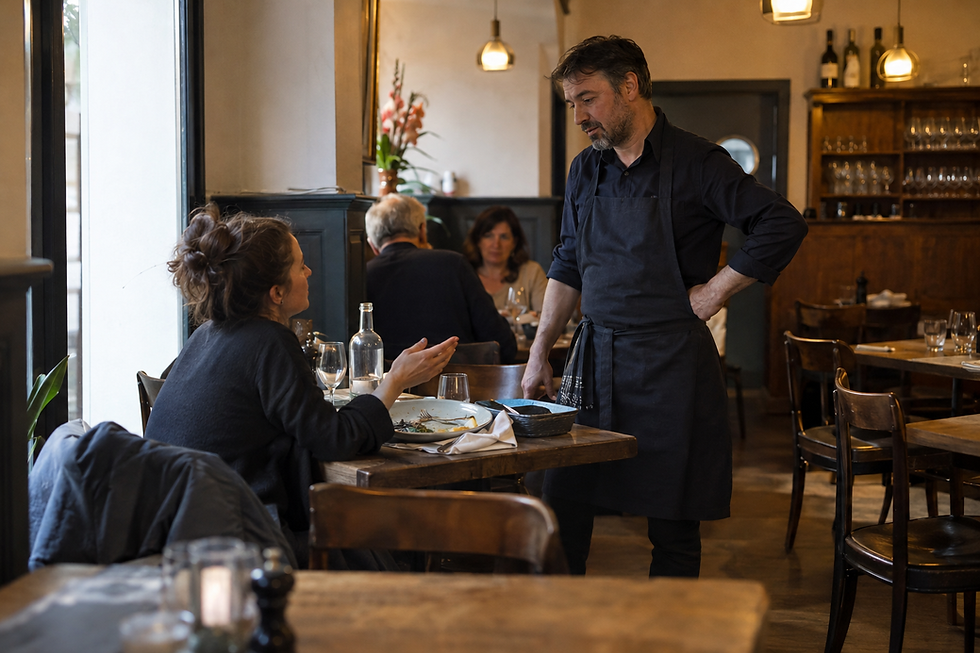
We ordered carbonara in an Italian restaurant. This is what we were served.
Last weekend, we were near Charleroi. In an Italian pizzeria, we ordered pasta described as pasta alla carbonara.
We will not say where, of course. Wallonie Gourmande is not here to name and shame a restaurant every time we are disappointed. What interests us is how and why: how can a dish still be served as carbonara today when it respects almost none of the ingredients, principles or technique behind it?
What we received was essentially pasta with bacon pieces, cream and industrially grated cheese added. All mixed together. Creamy, yes. But carbonara is not simply something creamy with pork in it.

Real carbonara looks simple. It is not.
Traditional carbonara relies on very few ingredients: pasta, eggs, guanciale, pecorino romano and black pepper. No cream.
Guanciale is not just Italian bacon. It is cured pork cheek or jowl, with a distinctive fat that melts during cooking and gives the dish a more intense flavour. More expensive than industrial bacon pieces, it cannot be replaced without fundamentally changing the flavour of the dish.
Pecorino romano then brings saltiness, intensity and the texture that helps build the sauce with the eggs. The quantity matters: too little and the sauce lacks character; too much and it dominates the dish. That is a world away from industrially grated cheese chosen because it melts easily and costs less.
Then there is the technique. A successful carbonara requires careful temperature control. The eggs, cheese, fat rendered from the guanciale and a little pasta cooking water must form an emulsion that coats the pasta without turning the eggs into an omelette. This is precisely what separates a smooth, glossy, almost silky sauce from a scrambled or heavy mixture.
So why is there so much cream?
Because cream often serves as a crutch for those who have not mastered the preparation. It quickly creates the illusion of a velvety sauce, whereas carbonara demands the ability to make an emulsion without cream.
Guanciale has a stronger flavour than ordinary bacon pieces: you need to know how to cook it and how much to use, so that it adds character without overwhelming everything else. Salty, intense pecorino romano also requires the right quantity. Even the eggs demand precise proportions and controlled heat: too hot, and the sauce sets instead of coating the pasta.
When those balances are not understood, the shortcut is tempting: mix bacon pieces and industrially grated cheese with cream. The dish becomes easier to reproduce, but it is no longer the same recipe. Real carbonara requires an understanding of what you are doing.
And that is the real problem. We have absolutely no objection to someone enjoying pasta with bacon and cream. It can even be a very good dish. But it should be called what it is.
A dish's name still means something
When you order carbonara, amatriciana, cacio e pepe or tiramisù, you are not ordering a vague idea. You are ordering an identifiable dish, with a history, ingredients and a way of preparing them.
Of course, cooking evolves. Recipes change, travel and adapt. It would be absurd to insist that a dish must remain unchanged for ever. But there is a difference between interpreting a recipe and removing almost everything that makes it distinctive, more technical or more expensive, while keeping its name because it sells better.
It is even sadder to encounter this in an establishment that presents itself as Italian. Not because an Italian should cook every recipe in exactly the same way, but because an Italian restaurant should at least understand the dish it is naming.
Customers have a responsibility too
It is easy to put all the blame on restaurateurs. But a restaurant generally keeps selling what its customers are willing to buy.
If everyone is happy with pasta in cream and bacon when it is labelled carbonara, there is little incentive to buy guanciale, pecorino and good eggs, or to train someone to master the emulsion properly.
That is why taking an interest in what we eat is not snobbery. Knowing a little about ingredients, recipes and techniques simply makes consumers harder to mislead. And that, in turn, encourages professionals to do better.
The more customers understand what they are ordering, the harder it becomes for people who have not truly mastered a cuisine to open a restaurant, borrow its conventions and serve anything they like under familiar names.
We are not asking every Italian restaurant to turn every plate into a demonstration of culinary purism. We are simply asking for some consistency.
Pasta with bacon and cream has every right to exist. But if you remove the guanciale, pecorino and technique, replacing them with cream, bacon pieces and industrially grated cheese, you no longer have a failed carbonara.
You have a different dish. So let us simply stop calling it carbonara.